How Aikou Aluminum Foil Heat Seal Containers Help Brands Comply with EU PPWR Recyclability Requirements

Last Updated on 16 March, 2026 by Luca
Table of Contents
I. Introduction
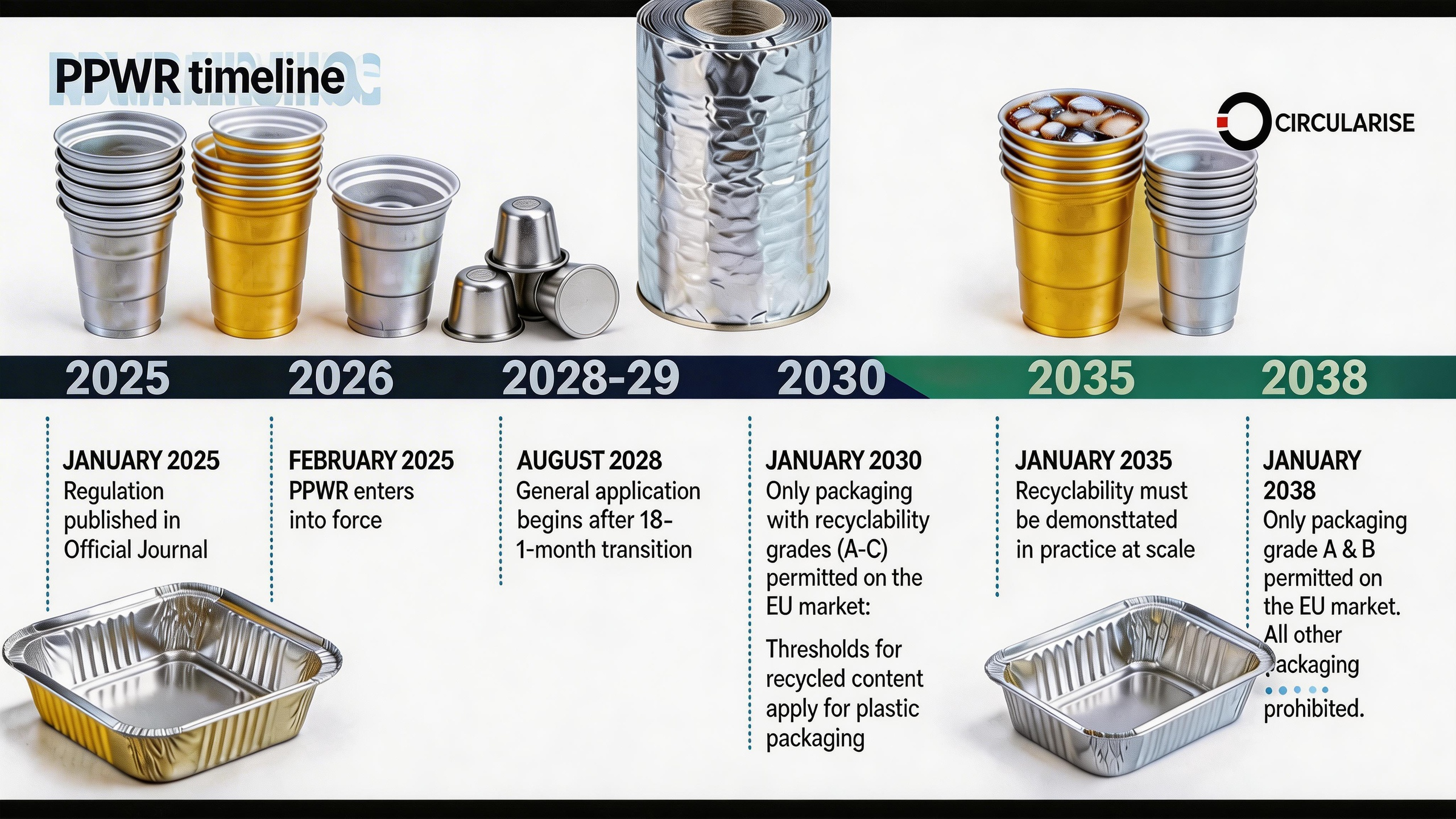
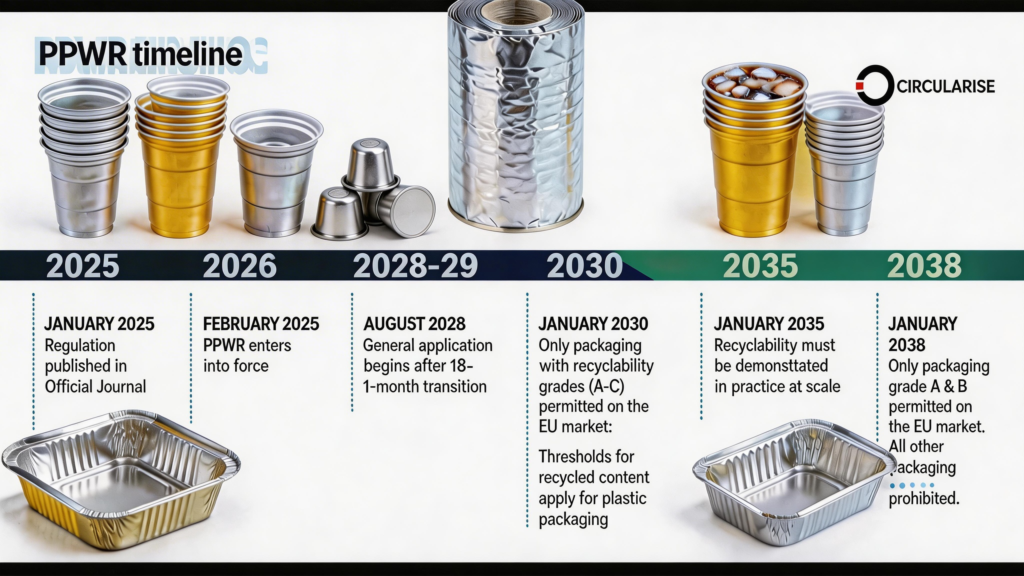
EU PPWR compliance aluminum foil containers.Less than five months remain until key EU PPWR provisions take effect. On February 11, 2025, the Packaging and Packaging Waste Regulation (Regulation 2025/40) entered into force, replacing the decades-old Directive 94/62/EC. This shift from directive to regulation means unified rules apply directly across all member states—no transposition, no loopholes.
By August 12, 2026, strict substance restrictions (PFAS limits, heavy metal caps) will apply to all EU packaging. By 2030, every package must be “recyclable” under the regulation—only A, B, or C grades permitted. By 2038, only grades A and B survive. Meanwhile, several European countries already levy “plastic taxes” on non-compliant packaging, adding financial penalties to regulatory risk.
Food brands, pharmaceutical exporters, and food service chains face an immediate supply chain reality: the search for recyclable-by-design, certifiable, and traceable packaging is already urgent. Aluminum foil—with infinite recyclability and mature recovery infrastructure—has emerged as the “safe choice” for PPWR compliance.
Aikou specializes in aluminum foil heat seal containers engineered for circularity. Our products meet international food-contact standards and are fully compatible with EU recycling systems. This article decodes PPWR’s core requirements, explains why aluminum foil is the compliance-friendly material, and shows how Aikou empowers your brand to turn regulatory pressure into competitive advantage.
II. Decoding PPWR — What “Recyclable” Means from 2030
PPWR fundamentally shifts packaging philosophy. As PwC experts note, “The regulation turns the traditional perspective on its head—moving focus from downstream waste treatment to upstream design.”
Key deadlines:
| Deadline | Requirement |
|---|---|
| February 11, 2025 | PPWR enters into force, repealing Directive 94/62/EC |
| August 12, 2026 | PFAS restrictions and heavy metal limits apply |
| January 1, 2030 | All packaging must be recyclable (grades A, B, or C) |
| January 1, 2038 | Only grades A and B permitted |
Quantitative definition of “recyclable”:
Article 6 of PPWR establishes a graded assessment:
- Grades A, B, C: designed for recycling, compatible with collection/sorting/recycling systems
- Recyclability below 70%: “technically non-recyclable”—banned from market after 2030
Multi-material laminates and difficult-to-separate composites that look recyclable on paper but fail in practice will be excluded from the EU market starting 2030.
Substance restrictions:
Beyond recyclability, PPWR imposes strict chemical limits:
- Heavy metals: lead, cadmium, mercury, hexavalent chromium ≤ 100 mg/kg (effective August 12, 2026)
- PFAS restrictions (food contact packaging):
- Quantitative monomeric PFAS (non-polymers) ≤ 25 ppb
- Sum of all monomeric PFAS (non-polymers) ≤ 250 ppb
- Total fluorine content for polymeric PFAS ≤ 50 ppm
Plastic tax overlay:
The EU Plastic Levy (€0.80/kg non-recycled plastic waste) has applied since 2021. Member states add their own taxes: Spain charges €0.45/kg on non-reusable plastic; the UK levies £223.69/tonne for packaging with <30% recycled content. These policies create a “compliance cost matrix”—less environmentally friendly packaging carries heavier tax burdens.
III. Aluminum Foil — The “Compliance-Friendly” Choice Under PPWR
Amidst PPWR’s tightening screws, aluminum foil emerges as the preferred material for forward-thinking brands. The answer lies in aluminum’s infinite recyclability and Europe’s mature recycling infrastructure.
1. Infinite recyclability without quality loss
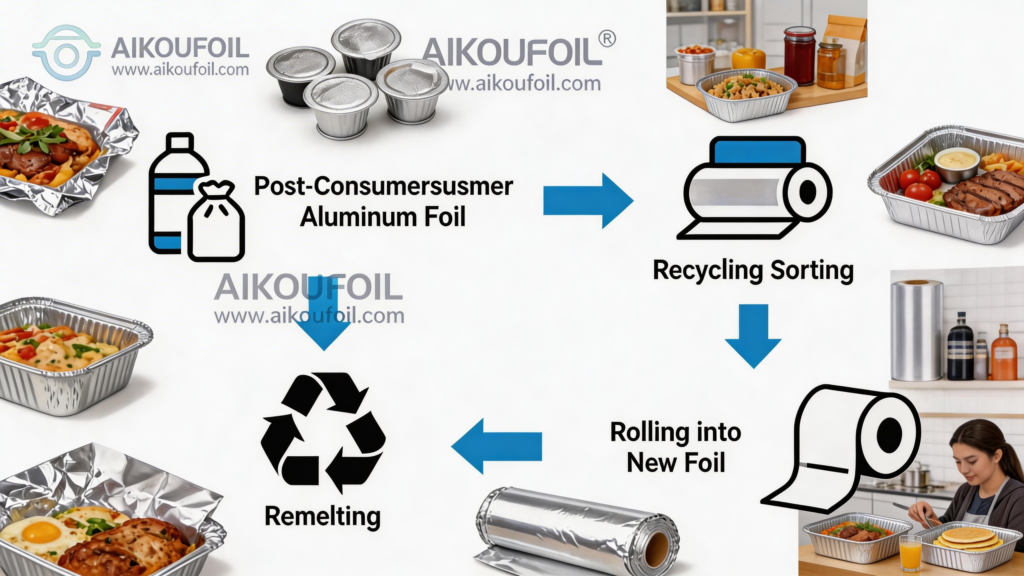
Aluminum is a permanent material—recycled infinitely without degrading inherent properties. Unlike plastics (which downcycle with each loop), recycled aluminum retains identical metallurgical characteristics as primary aluminum. Aluminum foil packaging can be recycled into new foil, beverage cans, automotive parts—closing the loop completely.
Recycling aluminum saves 95% of the energy required for primary production—directly translating into lower carbon footprints for brands using recycled-content foil, a powerful advantage for ESG audits and Scope 3 reporting.
2. Europe’s established collection and sorting systems
Aluminum packaging benefits from decades of recycling infrastructure investment. According to European Aluminium, the recycling rate for aluminum packaging reached 76% in 2022, targeting 80% by 2030.
Key enablers:
- Easy detectability: Eddy current separators efficiently sort aluminum in recycling facilities
- High scrap value: Aluminum commands premium prices, making recovery economically attractive
- Established design guidelines: Metal Packaging Europe and EAFA publish comprehensive “Design for Recycling Guidelines” for aluminum packaging
3. Contrast with plastic’s struggles
While plastic packaging scrambles to meet minimum recycled content requirements (10-35% by 2030), aluminum packaging already claims “100% recyclable” and often contains significant post-consumer recycled content. As the Single-Use Plastics Directive and national plastic taxes bite, plastic’s compliance costs rise sharply. Aluminum is already on the right side of the regulatory curve.
4. Market trends confirm the shift
Sustainability drives aluminum foil packaging growth. Research and Markets projects the global aluminum foil packaging market from $26.68 billion in 2025 to $35.72 billion by 2031, at a 4.99% CAGR—underpinned by brand owners pivoting from hard-to-recycle plastics to infinitely recyclable aluminum.
IV. Beyond Compliance — How Aikou Enables EU Market Success
PPWR compliance is entry ticket. Savvy brand owners turn “compliance” into “competitive advantage.” Aikou’s products and services enable that leap.
1. EPR registration and eco-modulated fees
PPWR strengthens Extended Producer Responsibility: any company placing EU packaging must register in each member state and finance collection, sorting, and recycling.
Crucially, EPR fees are eco-modulated—more sustainable packaging enjoys lower fees. By choosing high-recyclability aluminum foil packaging, brand owners significantly reduce EU EPR costs. Aikou’s mono-material aluminum containers qualify for lowest fee brackets in most EPR schemes.
2. Digital labelling and traceability obligations
Article 12 introduces harmonized labelling: all packaging must bear material identification code (e.g., “ALU” for aluminum) and may carry digital data carrier (e.g., QR code) linking to recyclability/disposal information.
Effective August 12, 2026, this means redesigning packaging graphics and establishing digital information systems. Aikou supports you with:
- Pre-printed/printable areas optimized for QR codes
- Guidance on compliant material codes
- Access to digital product passport platforms for end-to-end traceability
3. Supply chain accountability flows upstream
PPWR obligations propagate upstream:
- Packaging suppliers must provide compliance information
- Importers must ensure imported packaging meets requirements
- Distributors must verify producer registration and correct labelling
Your compliance level directly ties to your supplier’s capabilities. Aikou is prepared as the supplier you can rely on.
Aikou’s compliance toolkit includes:
- Material Composition Declarations: Certifying compliance with heavy metal/PFAS limits
- Recyclability Assessment Reports: Third-party validated documentation showing Grade A/B recyclability under PPWR methodology
- Recycled Content Certificates: Proof of post-consumer recycled content for claims and EPR fee modulation
- Labelling Support: Advice on harmonized material codes and QR code implementation
- Digital Product Passport Ready: Traceability system integrates with passport platforms for direct consumer/recycler information sharing
Contact Aikou Today
Ready to elevate your program? Contact our B2B sales team for a complimentary consultation and sample pack. We’ll help you navigate specifications, compliance requirements, and customization options tailored to your market positioning.
Email: [email protected]
Visit: www.aikou.com/aluminum-coffee-capsules